
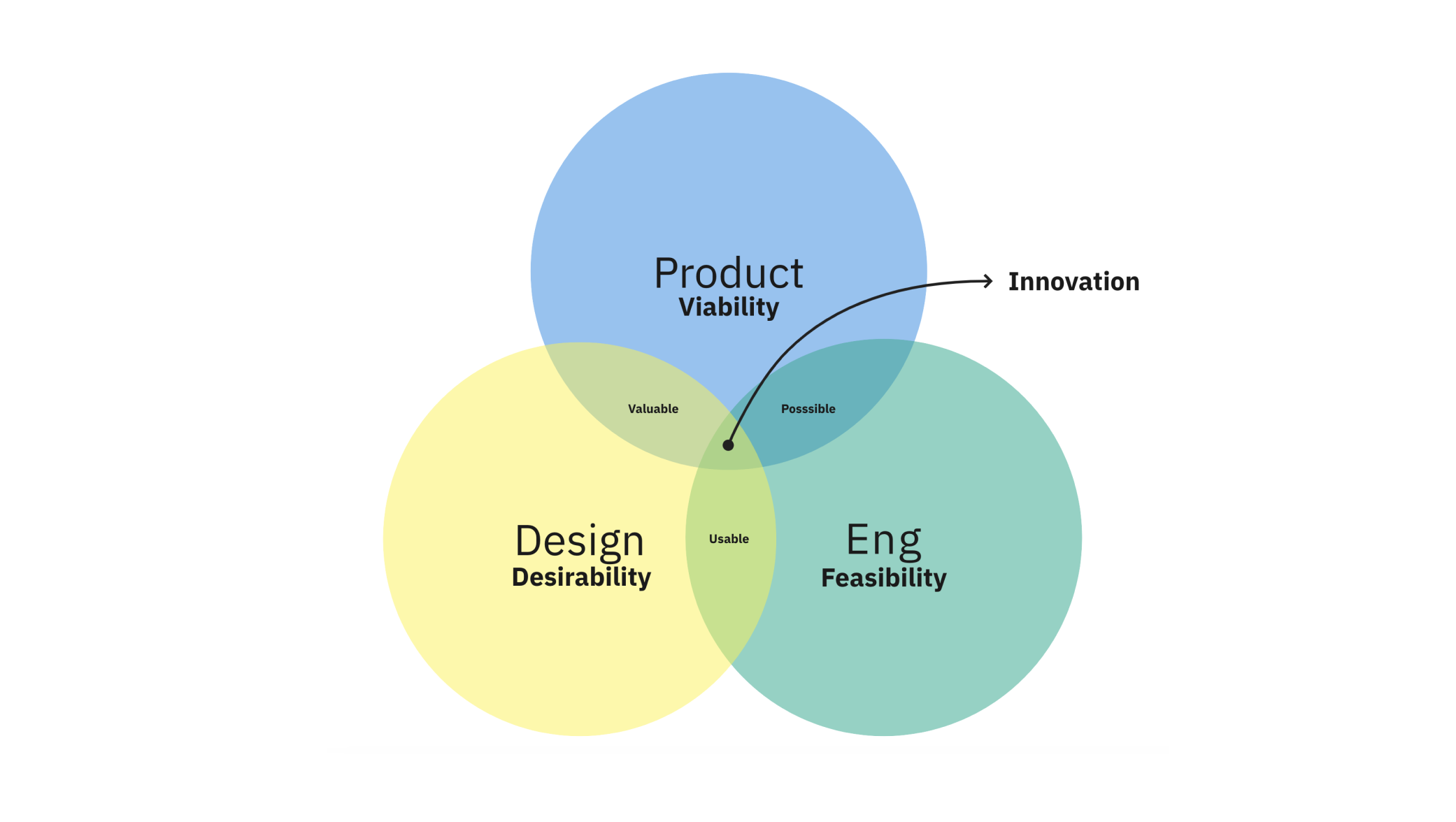
The traditional Product, Design, Engineering trio is dead. Long live proximity.
AI-assisted development has compressed timelines that used to take weeks into days, which is exciting until you notice what’s being culled in the name of speed: talking to the very users you’re building for.
Discovery is increasingly being treated as a luxury, something you do when the stars align and a stakeholder hasn't yet filled your calendar with something more urgent. But it isn't a phase you complete before the real work begins... It is the real work. It's how you find out whether the thing you're racing to build is the thing anyone needs, and without it you're not moving fast so much as failing more efficiently than you used to.
As the cost of execution falls, the premium shift - away from shipping, towards judgement. Towards knowing what to build and being able to defend that decision with something more rigorous than a confident tone of voice in a meeting.
What that judgement looks like
At Epsy, a health app for people living with epilepsy, we ran continuous user research where every week, someone on the team was in conversation with a patient, a carer, or a clinician, not because we had oceans of time but because we had seen what happened to teams that built on assumptions and gut feel, and had no interest in repeating the experience.
It started with a quarterly outcome tied to retention, and we betted the insights section of the app needed a redesign, in order to achieve our user outcome: to allow them to easily check their data to help them make better decisions, together with their doctors. It wasn't performing, the team had theories about why, and we were about ready to set the team loose on it before we looked harder at the analytics and discovered that users weren't going to the insights section at all - which does rather change the hypothesis.
When we spoke to users to understand why, the answer was both simple and humbling. They didn’t care for fancy charts or dashboards, they were taking screenshots of their daily logged data and sending the pictures to their neurologist via a third-party health platform. They had independently invented a workaround because what they needed was a way to share their data with their doctor.
We delayed the redesign and built a PDF export and a referral link instead, which took a fraction of the work we'd been planning, and it solved the most pressing problem. Discovery doesn't just improve the thing you're building - it stops you from building the wrong thing entirely, which matters considerably more when your team can ship in days rather than months.
The boundary was always political, not functional
In practice, the best discovery work rarely comes from whoever has "product" in their job title. It comes from whoever stayed closest to the user, whilst maintaining a deep understanding of what the business needs: the designer who ran research and shaped what was built, or perhaps the engineer who joined a user interview and heard something everyone else had missed.
The boundary between product and design, between strategy and craft, has always been more political than functional. In lean, high-performing teams it tends to dissolve almost completely, and what you're left with is simply the work: identifying the right problem, gathering the evidence, and making the call.
Product taste isn't something you develop in a job title. It develops in proximity — to users, to failure, to the moment you nearly built the wrong thing and caught it just in time.
I spent five years with "Head of Design" on my email signature while running continuous discovery, writing PRDs, defining product vision, and tying it all to commercial outcomes. A CEO I met recently, hearing me talk about continuous interviewing and evidence-based prioritisation, messaged afterwards to ask whether I'd consider interviewing for a VP of Product role. I don't think that says anything particularly remarkable about me. I think it says something about where product taste actually comes from, and how little the label on the tin has ever had to do with it.
